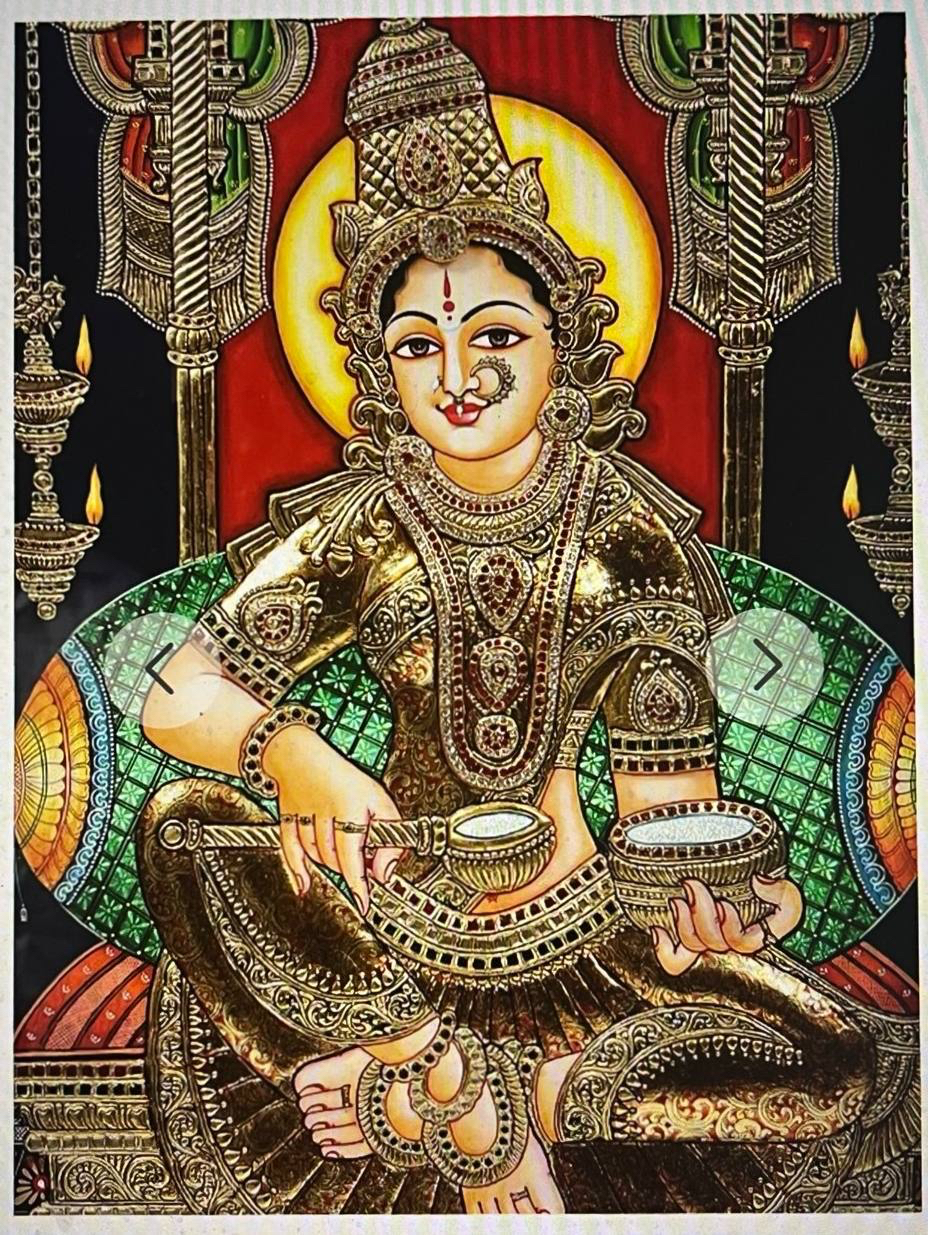
Annapurna Devi is revered in Hinduism as a Goddess of food. (Sanskrit: अन्नपूणार्, Annapūrṇā, filled with or possessed of food). She is the incarnation of Parvati Devi, wife of Shiva, and represents one of many forms of Shakti ( the "Universal Power" that underlies and sustains all existence ). In her role as Annapurna, she nourishes all living beings.
Lord Shiva and Parvati Devi often played the game of dice. As the story tells on one occasion the game became so captivating that they started placing bets. On this occasion, Shiva lost everything including his serpent, his trident and even his begging bowl. Feeling humiliated Shiva retreated to the forest. Lord Vishnu approached Shiva and asked him to play again against Parvati to retrieve his possessions. Following Vishnu's advice, Shiva played again and won all his possessions back. Parvati Devi, suspicious of Shivas' change of fortune, accused him of cheating. This led to a heated argument.
Lord Vishnu intervened and revealed that the dice moved according to His will and that both of them were just under the illusion of being able to control anything. This led to a further philosophical discussion in which Shiva declared that all possessions are temporary and everything is an illusion, including food. Devi Parvati disagreed, debating that if food was an illusion, then she, too, would be an illusion. She questioned the sustenance of the world without food, and then she disappeared.
Her disappearance caused Nature to come to a standstill. There were no seasonal changes, everything became barren, and there was no regeneration of birth. Soon, a severe food shortage followed. Shiva realised that he was incomplete without his Shakti. Devi Parvati, meanwhile, unable to see her children die from hunger, opened the kitchen in Kashi (Varanasi) and started distributing food in her incarnated form as Annapurna. Shiva approached her with his begging bowl, and Annapurna mercyfully gave him food to eat. Shiva admitted that food cannot be dismissed as a mere illusion as it is essential to nourish the body.
Since then, Annapurna Devi has been worshipped. This story underlines the importance of food in everybody's life, whether it is just material life or the spiritual journey towards liberation. Annapurna Devi provides both physical and spiritual nourishment, representing the divine source of sustenance, fostering gratitude and abundance and reminding us of the importance of sharing and compassion. Annapurna Devi elevates food beyond mere physical nourishment and shows us that food is also a Divine gift for which we should have a sense of gratitude rather than take it for granted. Her blessings are sought after to ensure that one's home remains a place of prosperity and abundance.
Lord Shiva and Parvati Devi often played the game of dice. As the story tells on one occasion the game became so captivating that they started placing bets. On this occasion, Shiva lost everything including his serpent, his trident and even his begging bowl. Feeling humiliated Shiva retreated to the forest. Lord Vishnu approached Shiva and asked him to play again against Parvati to retrieve his possessions. Following Vishnu's advice, Shiva played again and won all his possessions back. Parvati Devi, suspicious of Shivas' change of fortune, accused him of cheating. This led to a heated argument.
Lord Vishnu intervened and revealed that the dice moved according to His will and that both of them were just under the illusion of being able to control anything. This led to a further philosophical discussion in which Shiva declared that all possessions are temporary and everything is an illusion, including food. Devi Parvati disagreed, debating that if food was an illusion, then she, too, would be an illusion. She questioned the sustenance of the world without food, and then she disappeared.
Her disappearance caused Nature to come to a standstill. There were no seasonal changes, everything became barren, and there was no regeneration of birth. Soon, a severe food shortage followed. Shiva realised that he was incomplete without his Shakti. Devi Parvati, meanwhile, unable to see her children die from hunger, opened the kitchen in Kashi (Varanasi) and started distributing food in her incarnated form as Annapurna. Shiva approached her with his begging bowl, and Annapurna mercyfully gave him food to eat. Shiva admitted that food cannot be dismissed as a mere illusion as it is essential to nourish the body.
Since then, Annapurna Devi has been worshipped. This story underlines the importance of food in everybody's life, whether it is just material life or the spiritual journey towards liberation. Annapurna Devi provides both physical and spiritual nourishment, representing the divine source of sustenance, fostering gratitude and abundance and reminding us of the importance of sharing and compassion. Annapurna Devi elevates food beyond mere physical nourishment and shows us that food is also a Divine gift for which we should have a sense of gratitude rather than take it for granted. Her blessings are sought after to ensure that one's home remains a place of prosperity and abundance.
Additional comments from Babaji Satyanarayana Dasa: They were gambling just for fun. It is their leela or play. The significance is as follows: Shiva is pure consciousness, detached from everything. Parvati is shakti, creative power, the nourishing power or sustaining power.
Without shakti consciousness alone cannot do anything, without Śakti, Śiva is śava (a corpse); without energy, consciousness has no expression. Without food, life cannot exist—even for the Lord Himself. The episode affirms the primordial power of the feminine, the sacredness of food, and the unity of Brahman and Māyā—they are not two, but one divine play.
The story of Annapurna Devi can be found in the Skanda Puran